Sunday, December 20, 2015

Christmastime 2015 - a train for the Christmas tree

How iconic it has become to add to the Christmas ambiance by setting up a model train around the base of the Christmas tree. I've wanted to do this for years, but have always had my heart set on using a locomotive and a set of cars that date back to the late 1920s.

Several years ago I discovered some pre-war American Flyer O-gauge passenger cars marked with authentic Great Northern Railway logos and (most of them) bearing the "name-train" moniker of Oriental Limited. Over time I picked up over a dozen of the cars, nearly all through eBay auctions.

Over the past summer I finally got to searching for one or two operating American Flyer locomotives of the same vintage as the passenger cars I had been accumulating. I found two in short order, and took them both to Eastside Trains in Kirkland, WA, for servicing. Neither one required significant repairs (although one was not initially operating). Both were cleaned and lubricated, and they run fine.


A circa-1928 American Flyer 3112 box cab electric locomotive,
like the one I have and used in the video below.


As Thanksgiving neared (and with it, the pivot point on the calendar where the last morsels of leftover turkey are quickly disappearing and the Christmas decorations are going up in earnest), I went back to Eastside Trains and picked up a sufficient number of Fastrack curved sections to run a complete 5-foot diameter circle under our tree. I also bought an MTH RailKing Z-1000 transformer to power the train.

I laid down the track and hooked up the transformer. To accommodate the power cord for the Christmas tree lights, I put down a vintage O-gauge pressed steel tunnel that I had picked up in November at the annual Boeing Employees Model Railroad Club swap meet. The power cord lays over the tunnel so as to not interfere with the train and tracks.


I'm not much for "smart phones." They intimidate me to no end. They make me feel dumb. They're "smart," and me, not so much. "Oy vey!" as my Scandinavian forebears used to say. (that's a joke. Uff da!)

Anyhow, I finally figured out through trial and error (mostly error) how to shoot some video with my smarter-than-I'll-ever-be phone. I managed to download it to my computer, and edited the video by adding a couple of opening and closing frames and a sound track of the Glenn Miller Orchestra performing "We Wish You A Merry Christmas." If you are a fan of the Christmas standard "Christmas Story" that came out in 1983, you'll likely recognize this tune from the closing scene of the movie.

So, here it is, my first and fledgling effort at slapping together a video with my smarter-than-I'll-ever-be phone, and some video editing software.

And to paraphrase Glenn Miller and his orchestra,
I wish you a Merry Christmas, and a Happy New Year!


Sunday, August 9, 2015

GNRHS invited to participate in BNSF-Interbay celebration


BNSF Railway's 20th anniversary celebration
Interbay Roundhouse, Seattle, Washington
Saturday, August 8, 2015


BNSF – the corporate combination of the Burlington Northern and Santa Fe railroads – came about with the formation of a holding company back in September of 1995. Although the two companies did not formally merge as BNSF until December of 1996, the origin of the holding company is generally used to acknowledge the genesis of today’s BNSF. Ergo, the company is currently celebrating the 20th anniversary year.

Ten years ago, GNRHS was invited to join BNSF and its Interbay (Seattle) locomotive servicing employees in observing their 10th anniversary. GNRHS was ably represented at that time by members Bill Sornsin and Lindsay Korst. [Read about that event here:  http://www.gngoat.org/bnsf_turns_10.htm]

This year, both of those gents were unavailable, but in their stead GNRHS was represented by Bob Kelly, Andrew Klamka, and myself (Scott Tanner).

Map of Interbay Roundhouse. Photo by Andrew Klamka.


This event was once again organized for the purpose of recognizing current and former BNSF employees and their families with a day of fun. Many younger couples came out with their kids, while some older employees and retirees brought grandkids. This non-public event ran from 1100 to 1600, but set-up was well underway by the time we all arrived.

Bob, Andrew and I arrived at about 0900 and quickly set about putting up our displays. The temperature was in the mid-60s. BNSF had two large tents set up side-by-side. The weather that day was a tad iffy, especially for early August. It remained mostly overcast during much of the day, but it never rained. In fact, the sun made grudging appearances through the afternoon, and that warmed up the temperature to the mid- to upper-70s by day’s end.

Scott with some GN display items.
 

Standard 6-foot tables were arranged under the tents, toward the outer edges, in a large U-shape to maximize the space in the interior for folks to walk about. Bob brought a few hundred GN pinback buttons to hand out, along with an ample supply of “Rocky Booster” stickers. He also brought good supplies of GNRHS membership brochures and flyers about the Pacific Northwest Railroad Archive, the Skykomish Historical Society, and the “Great Northern Day” scheduled in Skykomish this year for Saturday, September 12th. Andrew Klamka will be a featured speaker at that event. He has been researching the movement of aircraft and aircraft parts by the Great Northern Railway over the years.

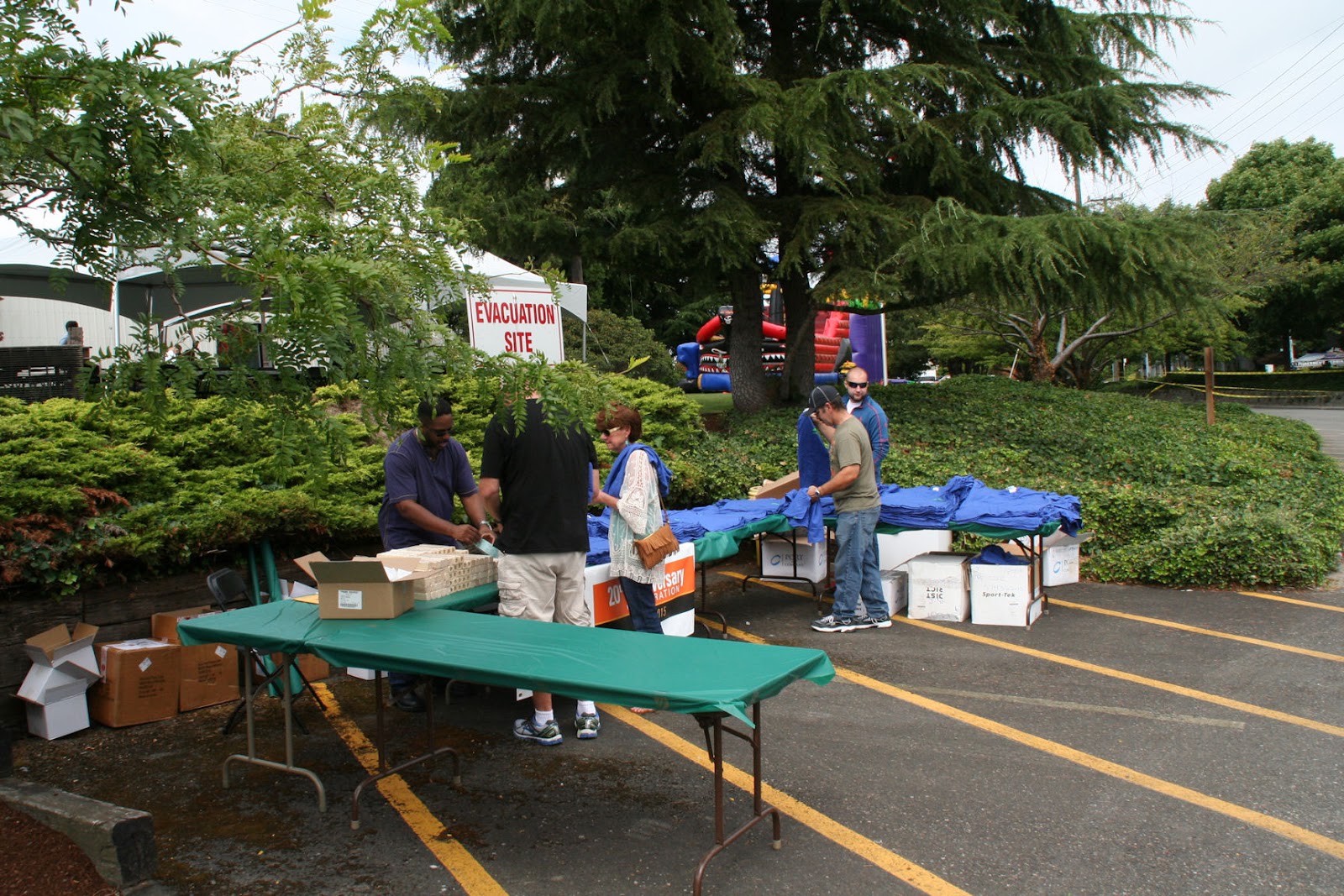
On one early break, I made it over to the check-in table that had been set up for employees and their families. I explained who I was and what I was doing there, and the nice guys running the tables quickly had me loaded up with a complimentary BNSF t-shirt, a meal ticket for the big picnic spread, and a couple of raffle tickets. I reported back to Bob and Andrew, and they made it over to pick up their goodies, too.

Check-in table. Blue BNSF t-shirts in nearly every size.
 
Alisha Walker was our contact at BNSF and to my knowledge was one of the key organizers (or perhaps THE key organizer) for the whole event. She works in Mechanical Administration for the Interbay Locomotive unit in Seattle. The set-up for the employees and their families was very big, and well-organized. It appeared that everyone, of every age, found fun things to see and do all day.

Bob, Andrew, and I took turns spelling each other at the tables. We all took a tour of the beautifully restored Great Northern caboose which was on display and open to all for a look-see. I had quite a conversation with BNSF’s Jim Lee (who helped coordinate things 10 years ago, and was the liaison for GNRHS that time) and a couple of other BNSF employees who had worked on the caboose.


Jim Lee of BNSF shoots a photo
for a BNSF employee and family.
Caboose interior.
There was a certain amount of disagreement and uncertainty about whether the caboose was first constructed by BN in 1980, or was of older vintage and was in fact originally GN. I asked one of the men who worked on it if the intention had been to utilize the GN markings to in some way keep old trademarks current for legal reasons, but he said he had never heard of any such intention. He said all he knew about it was that someone felt it would be a nice showpiece for Interbay to salute the GN heritage.

Photo by Andrew Klamka.


Traction motor on display. Andrew Klamka photo.


Jeff leads the tour.
Andrew and I also went on a tour of the Interbay Roundhouse, led by recently-retired Interbay worker Jeff Sappenfield. Jeff retired with over 40 years in railroading. He gave us a great tour of the facilities, beginning with a quick introduction to several mechanical items out on display. We walked through the massive Materials Department, where tons of spare and replacement parts are inventoried. Next we went into the 6-bay locomotive servicing area. The two outer bays do not have overhead cranes, because the clearance is much narrower in those bays and cannot accommodate the tracks needed at the ceiling to run the cranes.
Cylinder components.

One of the locomotives, BNSF #6903 (SD40-2), was open to visitors to climb aboard and inspect. We were encouraged to have a seat in the engineer’s chair, which of course I couldn’t pass up. Andrew noticed the placement near the center of the cab window of a “Loco Cam.” A BNSF employee confirmed our suspicion that it is used primarily like an aircraft’s “black box” to provide a video record in the event of a mishap of any kind. As far as I know, #6903 dates back to about 1973, when I presume it began life sporting “Cascade Green.” It was later painted in one of the BNSF Heritage schemes, but on this day was sporting the so-called “Nike swoosh” scheme.


Phoney hoghead.
BNSF 8122 (an SD60) takes a roundhouse bay alongside BNSF 6903 (an SD40).


Through one of the open roundhouse bays we could all view a nicely cleaned up SW1000 yard switcher, BNSF #3606. Built in 1972 and run as BN #381, this SW1000 is now used exclusively for yard service at Interbay (and in fact may have been from its start). We were told it has an alternate electrical power system that allows it to act a lot like one of the airplane tugs at the airport, shuttling the bigger locomotives into the roundhouse bays for servicing so the roundhouse does not fill up with diesel exhaust.


Bob Kelly brought a 7-foot-long photocopy of a circa 1922 blueprint of the Interbay Yard. This drew a lot of attention, especially from the older rails. Bob explained to some of the folks who came by that the roundhouse had originally been in another location. Or two (I wasn’t in on those discussions). I do know that at least one Interbay veteran was surprised to hear that.

Balloon Master Sculptor Adam Lee
at work (and play, at the same time!). http://adamlee.net/
Under the two tents we shared there were people representing “BNSF Wellness” (an employee health and fitness organization), the BNSF Police Force (with Operation Lifesaver materials), Employee Assistance Program, and a diversity council. There was also a fellow hired to entertain the kids (and adults!) with his terrific and creative balloon figures. He brought an elaborate balloon sculpture representation of a BNSF locomotive, which was a huge hit. Especially for the lucky kid he gave it to near the end of the event.

Topsy Turvy Bouncers also provided some bounce houses for the kids to play in, as well as a dunk tank that featured several foremen and managers that their employees delighted in getting wet.


People literally pulled up chairs to listen hopefully for
their tickets to be called. Nearly everyone took home something.


Two separate raffles were held, with dozens of prizes handed out. Between us, Bob, Andrew, and I were issued a total of 6 raffle tickets. Five of our numbers were called. Bob and Andrew each decided they didn’t need any more coffee mugs or beer coozies at home, so I ended up with all of those. When the two “big prize” tickets were called (both during the first of the two raffle sessions), all that was left was a little girls’ pink bicycle. None of us had use for that, so we told the folks to draw again. Other “big prizes” were more very nice bicycles, a BNSF golf bag, several beginner fishing pole sets with lures, and a 3-burner gas grill. There were plenty of happy folks who took home goodies.

This was once again a very nice event, and a lot of fun for the GNRHS to participate in. Several rails showed keen interest in the GN history and even the possibility of joining the society. A few of the older retirees we visited with are honest-to-goodness GN veterans, so they seemed to especially appreciate the effort to keep the GN spirit alive and on people's minds. Some folks we spoke with said they have historic photos they’d like to share, and Bob made contact with them for follow-up.

It would be great to be able to do something similar again some time – with any luck, maybe sooner than ten years out. But even if it’s another ten years, we’ll be willing!


There's always time for a railfan grab shot! BNSF 6236 is on the point, sporting the paint scheme BNSF introduced in 2005 to help celebrate the 10-year anniversary. How appropriate.
 

Wednesday, December 24, 2014

Wishing you a GREAT (Northern) Christmas!

Here's a little treat from the newspaper archives:

Artist George Hagen. Published in the Seattle Post-Intelligencer, 1905

Saturday, March 1, 2014

A tribute to Frank Perrin - GN publicity man

Frank Perrin addressing the GN Cascade Division Reunion on September 13, 1995

Frank Perrin passed away on February 22, 2014, in Lacey, Washington, at the age of 96.

This blog post about Frank Perrin is a personal tribute to a man I knew only a little bit. I first met him in 1995, and although he lived for several years in Lacey, Washington, in the same retirement community as my own parents, I failed to go see him more than a couple of times. Visits with my parents are always far too short, and I regret never finding more time to break away to say hello to Frank. I did not interview him beyond the few brief chats that I had with him.
 

This is not an obituary – I did not know him nearly well enough to write something like that with any authority. Rather, what you read here consists of a few snippets of things I recall about him and fragments of the few conversations we had. I’ve also located a few relevant sources on the internet to fill in a bit more detail, although I have not yet located more than a death notice (in the Daily Olympian newspaper) since his passing – certainly not an obituary.

In 1995, the annual reunion of the Cascade Division GN veterans extended a welcome to any interested GN supporters and enthusiasts, specifically any interested members of the Great Northern Railway Historical Society (GNRHS). I accepted that invitation and attended the event in Everett, Washington. I brought along my rather primitive (by today’s digital standards) Hi-8 video camera and managed to record Frank’s presentation on his days in the service of the Great Northern Railway.

Franklin F. “Frank” Perrin was born about 1917 or 1918 to Lona and Neva Perrin. His brothers John and Douglas predeceased him, as did his wife Jeanne, who passed away in 2006. I believe Frank and Jeanne had children, and grandchildren, but I did not get to know him well enough to report about them at all.

When my Reference Sheet about Winold Reiss was published by GNRHS in June, 1996, Frank was kind enough to take the time to write me a letter and congratulate me on the article. I certainly took this as high praise, coming from a man who worked in publicity and advertising for the GN while Reiss was still living, and while Reiss’s work was still being prominently utilized in GN advertising. It meant a lot to me that Frank enjoyed my article, and that he wrote to tell me that.

Frank served our country in the U.S. Navy during WWII. Upon his discharge in 1945 (shortly after V-J Day), Frank signed up with the Great Northern Railway in the position of “Public Relations Representative.” A graduate of the University of Minnesota’s School of Journalism, Frank honed his skills in photography in the Navy, then applied those skills photographing nearly every significant event along the GN – specifically in the Cascade Division – for a period of about ten years.

Describing his career with the GN, Frank once stated “my job took me into every department and virtually every operating area of the railroad.” He was issued a pass when he first took the job, which granted him access to locomotives and cabooses to travel and conduct his work. He described his reaction to this fact as feeling like a kid in a candy shop.
 

When the Hedrich Blessing photography company of Chicago was hired by the GN to produce a large portfolio of publicity photos, they involved one of their younger photographers, Bob Harr. Frank told me once that Bob Harr always liked to have people in his photographs (or this may have been a preference of either GN or Hedrich Blessing management). When you see some of the iconic GN publicity photos of the 1950’s and 1960’s, you immediately recognize this style. Perhaps there is a cowboy on horseback, waving at the locomotive crew from a ridge above the railroad grade. There might be a fly-fisherman casting in a stream as the gleaming Empire Builder rolls by. In a couple of commonly used photos of the Empire Builder skirting Puget Sound, two men are seen just off shore in a small skiff. In many of those photos, Frank Perrin was on hand to supervise the shoot, and on more than one occasion filled in as a “warm body” to appear in the image. He told me he was one of the two men in the skiff in the shots along Puget Sound. The little boat the men are in has “Picnic Point” painted on its side. The photo was likely taken just south of Picnic Point, which is located between Edmonds and Mukilteo, Washington. With two dome cars and a great dome car visible in the image, this photo was probably taken in 1956 when the dome cars were introduced.

Great Northern publicity photo by Hedrich-Blessing, circa 1956, taken near Picnic Point south of Mukilteo. Frank Perrin is one of the two men in the small boat.

Frank was transferred to St. Paul in about 1956, where he worked with Charles W. “Dinty” Moore. When Moore retired as Executive Assistant of Public Relations for the GN on July 1, 1968, Frank Perrin was promoted into that position to replace him. Pat Stafford then took Frank’s old job.

During his presentation at the Cascade Division Reunion in 1995, Frank thoughtfully acknowledged the contributions of all of the GN veterans in attendance. Speaking to the audience, he said “if there’s one thing I learned in more than 30 years in PR, it’s that most of you have some pretty solid ideas of your own about public relations. In one way or another, you’ve all helped shape the Great Northern’s public image. It is to your credit that the GN was, and still is, regarded as one of America’s great railroads.”


Later in his talk, Frank also extended special appreciation for others who have done their share to help ensure that the history and the tradition of the Great Northern Railway live on. Please view to video clip below to see and hear Frank in a message that could have been recorded today, rather than nearly 20 years ago. He may have been addressing you.



Franklin "Frank" Perrin

I am sorry to report the passing of Frank Perrin, aged 96, on February 22, 2014.

I just learned of this news today.

Frank was in the Advertising and Publicity Department of the Great Northern Railway.

I will attempt to find and report a little more information about Frank in the near future.

Friday, January 24, 2014

William P. Kenney


January 24 - On this date in 1939

William P. Kenney, President of the Great Northern Railway (1932-1939)


Exactly 75 years ago, William P. Kenney passed away. At the time, he was just beginning his eighth year at the helm of the Great Northern Railway. Kenney was promoted into the position of President upon the departure of Ralph Budd, who was hired at the outset of 1932 to run the Chicago, Burlington, & Quincy Railroad (also known as the CB&Q, or “Burlington Route”). Bill Kenney’s tenure with the Great Northern was 37 years, with another 17 years in railroading prior to that. He was 69 at the time of his death; he started out in railroading at the age of 17 with the Chicago Great Western Railway, joining the GN in 1902.
 
There’s a story that less than one year prior to his death, Kenney received an extortion note at his office, demanding $100,000 and threatening him with kidnapping and bodily harm. The people threatening him tried to negotiate their criminal deal through newspaper want ads, but abandoned their scheme when it was revealed that Federal investigators had entered the case. Nevertheless, a guard was assigned to keep watch for him for many weeks.

From an obituary published in The Daily Interlake (Kalispell, MT) at the time of his death, here’s some more background on his career with the Great Northern Railway:

“In 1902 he joined the Great Northern as Chief Clerk in the freight department and advanced rapidly under the regime of James J. Hill. In 1904 he became assistant general freight agent, advanced a few months later to assistant to the vice president in charge of traffic. In 1907 he became assistant traffic manager, in 1911 general traffic manager, and in 1912 he became traffic vice president.”
It was from this position as traffic vice president that Kenney ascended to the office of president of the railway.

Good luck, pal - you're gonna need it!
Ralph Budd (standing) congratulates Bill Kenney (seated) on his ascension to the position of President of the Great Northern Railway
It is worth noting that William Kenney took the helm of the GN when the company was struggling through one of its most challenging financial times. With the 1929 stock market crash still a fresh memory, the Great Depression had taken hold of the nation when Kenney took ultimate responsibility for one of the largest railroads in the country. In all its history (right up to the 1970 merger that resulted in the formation of Burlington Northern), the Great Northern Railway never failed to pay dividends to its stockholders. With the weight of that legacy on his shoulders, it is understandable that Kenney counted among his highest priorities the need to reduce expenses across the board. I do not pretend to be an expert on the business history of the Great Northern Railway, but from what little I’ve read about this era of the railway, Kenney seems to have done an admirable job guiding the company successfully through this rough patch.

 
There is a tale – a legend perhaps – that credits Bill Kenney with the inspiration to incorporate the image of a mountain goat into the company’s logo. The story goes that a young Bill Kenney sold papers in Minneapolis (a claim that appears to be credible, according to other accounts of his life). A Great Northern press agent known for spinning outrageous yarns, one Hoke Smith, released a press statement around 1922 claiming that Kenney, as a lad, decided to haul his papers around in a goat cart. He owned a few goats for this purpose, but eventually he is said to have sold his goats to a man in Midvale, Montana (later named Glacier Park Station, and known today as East Glacier), who had a wild idea that he could breed these billy goats with Rocky Mountain Goats (which as I understand it are more closely related to antelopes). It seems highly unlikely – impossible? – to interbreed these animals. In any event, Kenney made it back to Midvale several years later (apparently, not long after Glacier National Park was created in 1910), and was informed that the fellow he had sold his goats to had passed away. When asked about the fate of the goats, his informant declared the hills were full of them. While inspecting the area with Louis W. Hill, President of the GN at that time, Kenney spied a goat that reminded him of his long-bearded billies, and he told Hill it must be a descendant of one of his own goats. To that, Hill allegedly replied, “here’s our trademark, Bill.” [My thanks to author and Glacier National Park historian Ray Djuff for sharing this story with me]


Some examples of early uses of goat motifs in Glacier National Park/Great Northern Railway publicity - these are luggage stickers from the 1912-1918 era (author's collection):


Thursday, January 16, 2014

Railroad or Railway?

Which is correct, Great Northern Railroad, or Great Northern Railway?

Click here to find the answer:

Saturday, December 14, 2013

Contact me!

If you have information about the Empire Builders radio series (i.e., you have or know where to find press photos or scripts, or you are the descendant of someone who was associated with the radio series, etc.), please contact me at:


Welcome to GN Rocky's new blog!


I do not have much technical understanding of the operations of a railroad company. You might find that surprising, given the topic of this blog. I hate to say “show me one locomotive and I’ve seen ‘em all,” but that’s not far off the mark for me. I am a collector of Great Northern Railway artifacts and memorabilia, and from these items I get the inspiration to learn more and to share the results of my research.

I plan to begin my blogging with information about a 2 ½ year advertising campaign conducted by the GN from 1929 to 1931. This was the Empire Builders radio series, broadcast coast-to-coast on NBC radio.

Eventually, I expect my blogs will evolve to include information on a range of topics concerning GN history and the artifacts that we can use to learn about it all.

While I am happy for others to find value in my material and incorporate it in their own work, I request that users of this site will respect my time and talents in how they use that material. Please follow established “fair use” guidelines and applicable copyright laws. If you make use of my material, I ask that you contact me to let me know how and where you plan to use it, and obtain my permission first if you plan to distribute the material in any way. Any distribution of my material or significant use of the content of this site should be acknowledged with a standard form of attribution or citation for your source.

Having said that, please contact me immediately if you are aware of any specific concerns about how I have used any material on this site. Let me know if you have factual evidence that I have used anything that is protected by copyright held by you or someone else.
 
Please feel free to post comments and/or contact me directly regarding anything on this site. I am eager to have your participation, and maybe we can generate some good discussion among many site visitors on topics found here. I reserve the right as blog owner to moderate all content in order to preserve a place for open and respectful discourse. If you encounter any content, posted by me or anyone else, that you have issues with, contact me at:


Search This Blog